Women over 40
Strength training with osteoporosis: what's safe and what to skip
Jonathon PirpichNASM-Certified Personal Trainer5 min read
The short answer
Strength training is generally safe and helpful with osteoporosis when it's progressive and well supervised. In the LIFTMOR trial, postmenopausal women with low bone mass who lifted heavy twice a week under supervision gained spine bone density while the control group lost it. Skip crunches, sit-ups, toe touches and powerful twisting, and get your doctor's okay first.
If you've been told you have osteopenia or osteoporosis, someone has probably also told you to be careful. Fair. But "careful" has quietly turned into "don't lift anything heavy," and for most women that advice is backwards.
Bones respond to load the way muscles do. Give them a reason to get stronger and they adapt. Take the reason away and they don't. The trick is giving them that reason safely.
Is strength training safe with osteoporosis?
For most women, yes, when it's progressive, supervised, and cleared by your doctor. The International Osteoporosis Foundation states plainly that progressive resistance training is safe for people with osteoporosis (IOF).
The danger usually isn't the lifting itself. It's specific movements done badly, and loads that jump too fast. Both of those are solved by coaching, which is why the trials that show the best results were supervised.
What did the LIFTMOR trial find?
Heavy, supervised lifting improved bone density in postmenopausal women with low bone mass, with no significant adverse events reported. That's the headline from LIFTMOR, the trial most people in this field point to (JBMR, 2018).
The setup: 101 women averaging about 65 years old, all with T-scores below -1.0 (low bone mass). Half did 8 months of twice-weekly, 30-minute supervised sessions at high intensity, 5 sets of 5 reps above 85% of their one-rep max. The other half did a low-intensity home program.
| Measure after 8 months | Heavy supervised lifting | Low-intensity home program |
|---|---|---|
| Lumbar spine bone density | +2.9% | -1.2% |
| Femoral neck (hip) bone density | +0.3% | -1.9% |
| Significant adverse events | None reported |
Two 30-minute sessions a week is 1 hour out of 168. For a spine-density gap of ~4 percentage points between the groups, that's about as good a trade as exists in fitness.
Two honest caveats. These women were screened, started gradually, and were coached on every rep. And 85% of a one-rep max is a destination you build toward over weeks.
What exercises should you avoid with osteoporosis?
Skip loaded forward bending of the spine and powerful twisting. The IOF specifically advises avoiding trunk flexion exercise because it may increase spine fracture risk, and avoiding powerful twisting movements of the trunk.
In practice that means no crunches, no sit-ups, no toe touches, no rounded-back lifting, and no fast rotational moves like golf-swing drills with weights. Deep forward bends while carrying something heavy, like lifting a full laundry basket off the floor with a rounded back, fall in the same bucket. Trunk extension and stabilization exercises are generally considered the safer core options.
What exercises are good for bone density?
Two kinds: weight-bearing exercise and muscle-strengthening exercise. The Bone Health and Osteoporosis Foundation recommends both (BHOF).
- Weight-bearing: brisk walking, stair climbing, hiking, and if your doctor allows it, higher-impact work like jogging or jumping
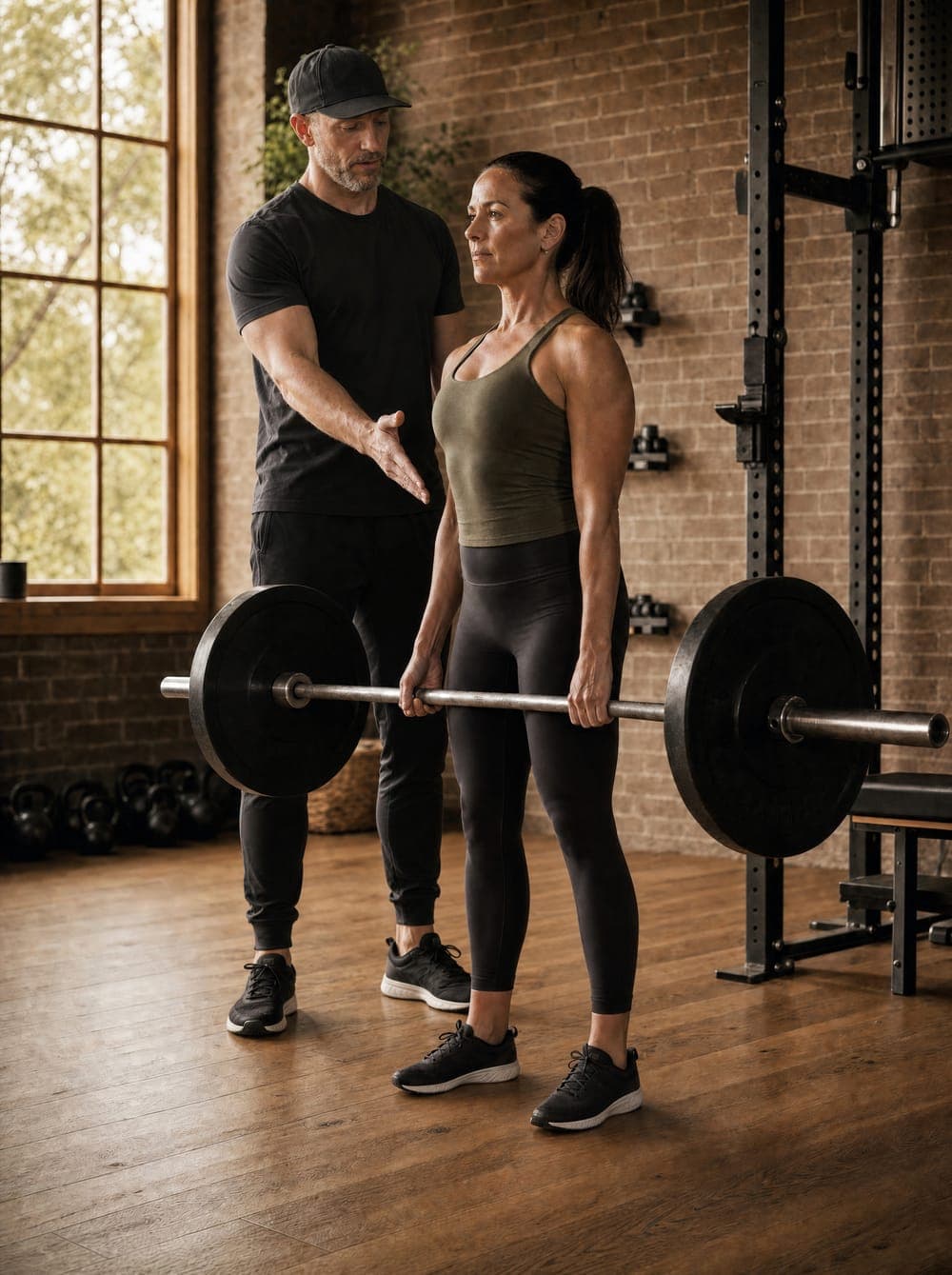
- Strengthening: squats or leg press, hip hinges done with a flat back, rows and other pulling, presses, carries
- Balance work, which the IOF calls highly recommended alongside strengthening, because the best fracture is the one where you never fall
One thing that surprises people: BHOF notes that biking and swimming aren't weight-bearing, so they don't help your bones much. Keep them if you love them, and add something that loads your skeleton.
How should you start lifting with low bone density?
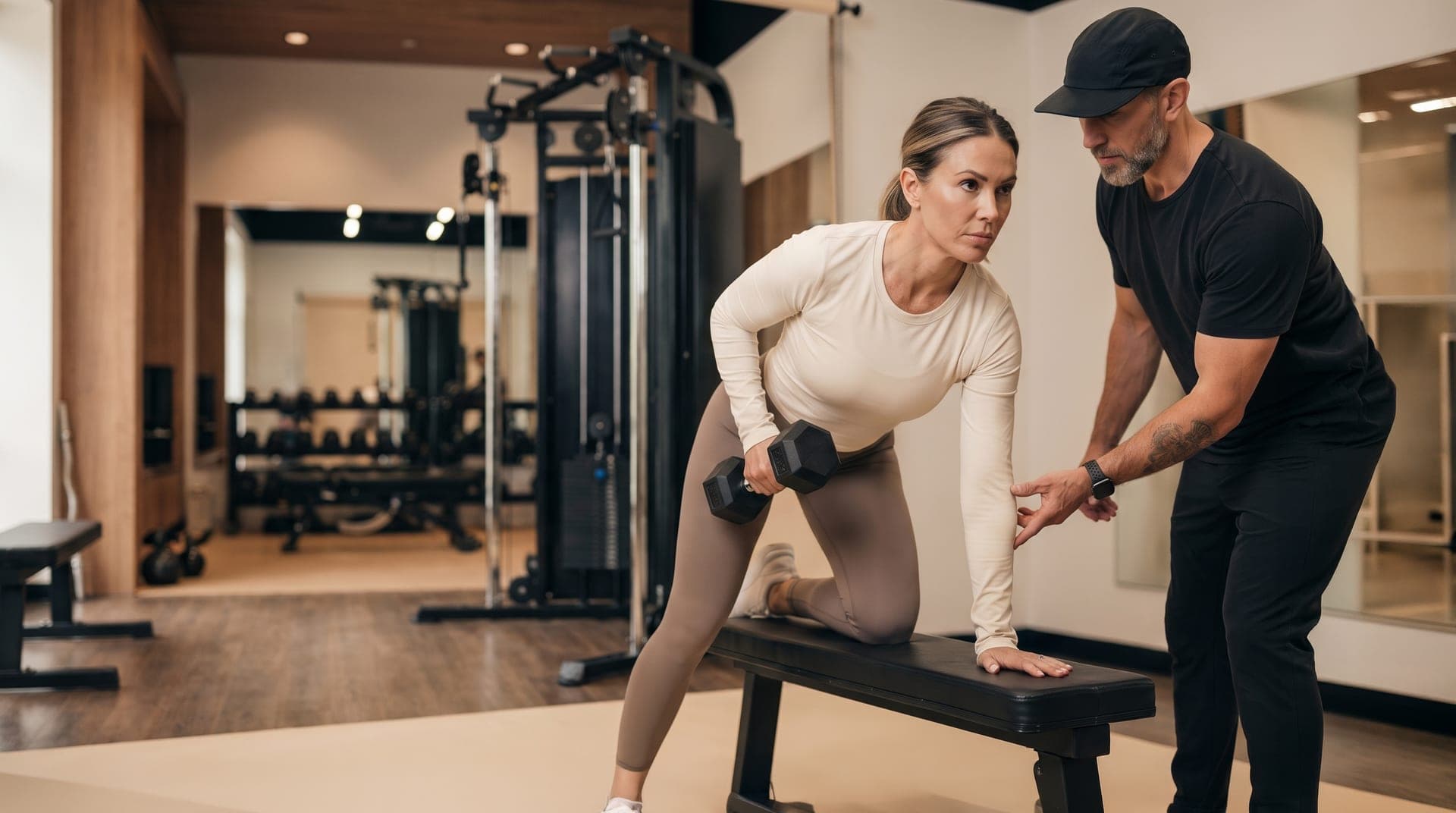
Get your doctor's okay, start lighter than you think you need to, and progress slowly with someone watching your form. The first month is about learning the movements. Testing limits can wait.
- Bring your latest bone density results and any restrictions to your first session.
- Learn the hip hinge first. Lifting with a flat back is the single most protective skill.
- Start with loads that leave 3 to 4 reps in the tank, then add weight in small steps.
- Add balance work every session, even 5 minutes.
- Train twice a week and keep it boring. Consistency over months is what moves bone.
If you've never lifted at all, the first month is laid out in strength training after 50 when you've never lifted.
Why does muscle matter for bones too?
Because muscle is what pulls on bone, protects joints, and keeps you upright when you trip. Losing it raises your fall risk at the same time bone density is dropping.
The Office on Women's Health puts natural muscle loss at about 3 to 5% per decade starting around age 30, becoming more noticeable by 60 (womenshealth.gov). Protein matters here too. I broke down the numbers in how much protein women over 40 actually need.
When should you not train without a doctor first?
If you've had a recent fracture, especially of the spine or hip, have very low bone density, or have other conditions like heart disease or uncontrolled blood pressure. Get specific clearance and ask what's off-limits.
A good coach programs around your doctor's guidance. That goes for menopause-related changes too: how much strength training you need in menopause covers the general weekly targets.
Getting help in Flower Mound
If you've been told to be careful and nobody has shown you what careful lifting actually looks like, that's exactly the gap I fill. Here's how training for women over 40 works at my studio.
One pitch. The free 6-Week Challenge starts with a body-composition scan, and every session is coached rep by rep. Bring your bone density results to the intro visit and we'll build the plan around them.
Common questions
Is it safe to lift weights with osteoporosis?
For most people, yes, with supervision and your doctor's okay. The International Osteoporosis Foundation says progressive resistance training is safe, and the LIFTMOR trial found no significant adverse events with supervised heavy lifting in women with low bone mass. Form and progression matter a lot.
What exercises should you avoid with osteoporosis?
Avoid trunk flexion like crunches, sit-ups and toe touches, plus powerful twisting of the spine. The International Osteoporosis Foundation advises against both because they may raise spine fracture risk. Deep forward bends while carrying something are also worth skipping.
Can strength training reverse osteoporosis?
It can improve bone density, and it still doesn't replace medical treatment. In LIFTMOR, spine bone density rose 2.9% over eight months in the lifting group versus a 1.2% loss in the control group. Your doctor manages the diagnosis and medication.
Is walking enough for bone density?
Walking helps, and it's a weight-bearing activity, but it's a light load. Adding muscle-strengthening work gives bones a bigger signal. The Bone Health and Osteoporosis Foundation recommends both weight-bearing and strengthening exercise.
Is swimming good for osteoporosis?
Swimming is great for your heart and joints, but it isn't weight-bearing, so it doesn't help your bones much. The Bone Health and Osteoporosis Foundation suggests adding weight-bearing activities if you swim or bike.
Sources
- High-intensity resistance and impact training improves bone mineral density and physical function in postmenopausal women with osteopenia and osteoporosis: the LIFTMOR randomized controlled trial. Journal of Bone and Mineral Research, 2018.
- Exercise for individuals with osteoporosis. International Osteoporosis Foundation.
- Exercise for your bone health. Bone Health and Osteoporosis Foundation.
- Sarcopenia. Office on Women's Health, U.S. Department of Health and Human Services.
This article is general fitness education, not medical advice. Check with your doctor before starting a new program, especially if you are pregnant, postpartum, on medication, or managing a health condition.