Women over 40
Strength training after 50 when you've never lifted
Jonathon PirpichNASM-Certified Personal Trainer5 min read
The short answer
Start with two full-body sessions a week built on five movements: a squat, a hip hinge, a push, a pull and a carry. Use weights light enough to leave two or three reps in the tank, add a little load when that gets easy, and give it a month before judging. The CDC recommends at least two days of muscle-strengthening a week for every adult, at any age.
Most women who start lifting after 50 have the same worry: I'm going to look silly, or I'm going to get hurt. Both are fair. Both are mostly solved by doing the boring version first.
Here's the boring version. It works.
Is it too late to start strength training after 50?
No. Muscle responds to training at 50, 60 and well past that. What changes is the starting point, so the first month is about learning movements and building tolerance. Heavy comes later.
The reason to start now is simple math. The Office on Women's Health puts natural muscle loss at about 3 to 5% per decade starting around age 30 (womenshealth.gov). At 55 that's ~2.5 decades, so ~7.5 to 12.5% of your muscle is already gone if you've done nothing about it. On ~50 pounds of muscle at 30, call it ~4 to 6 pounds. Every year you wait adds to that number. Every month you train takes some of it back.
How often should you strength train after 50?
Twice a week to start. That's the CDC's minimum of 2 days of muscle-strengthening for every adult, alongside 150 minutes of moderate activity like brisk walking (CDC).
Leave at least one day between sessions. Monday and Thursday works. So does Tuesday and Friday. Two 60-minute sessions is 2 hours out of your 168, which is a pretty cheap insurance policy on the next 30 years.
What exercises should a beginner over 50 learn first?
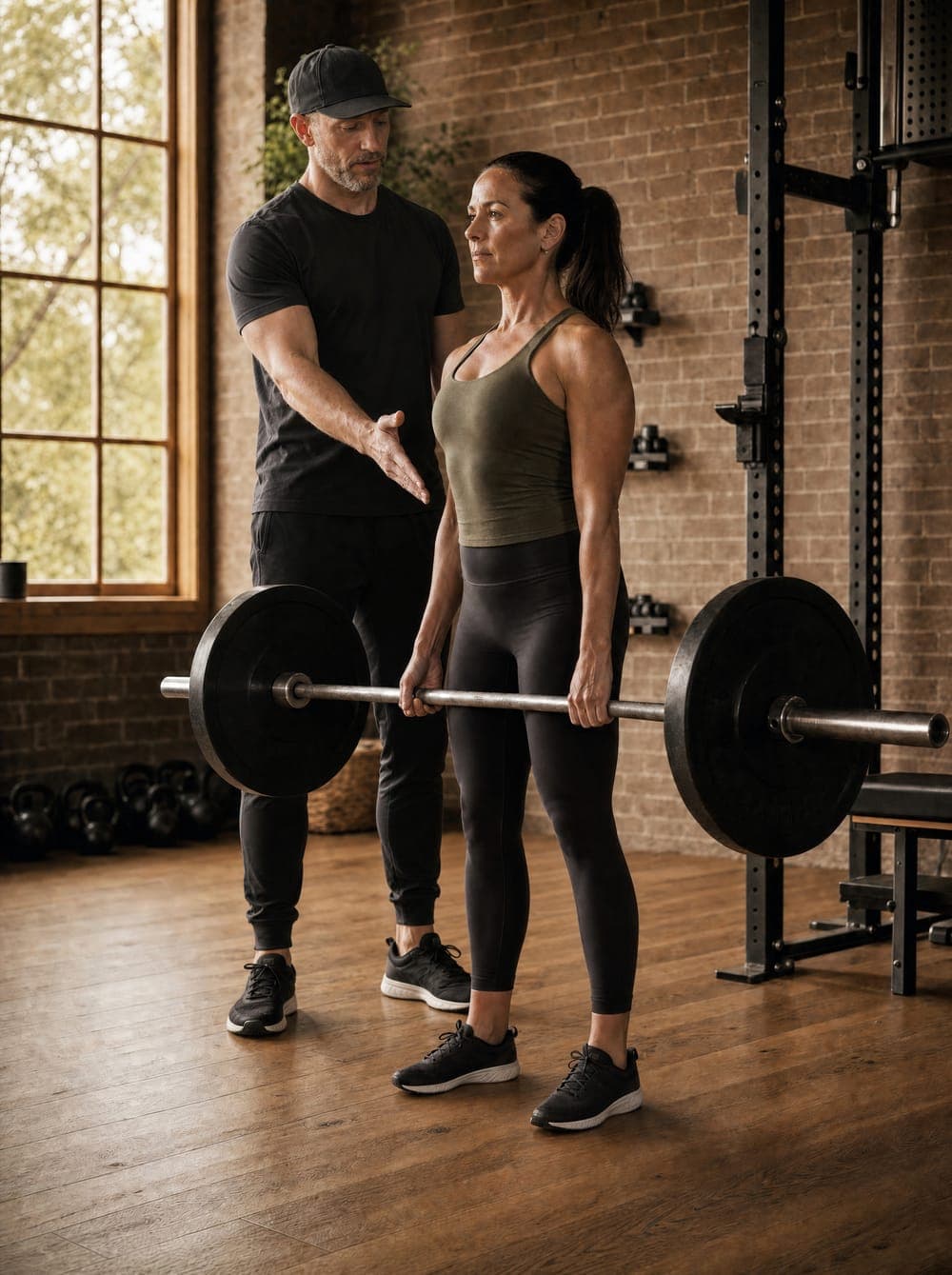
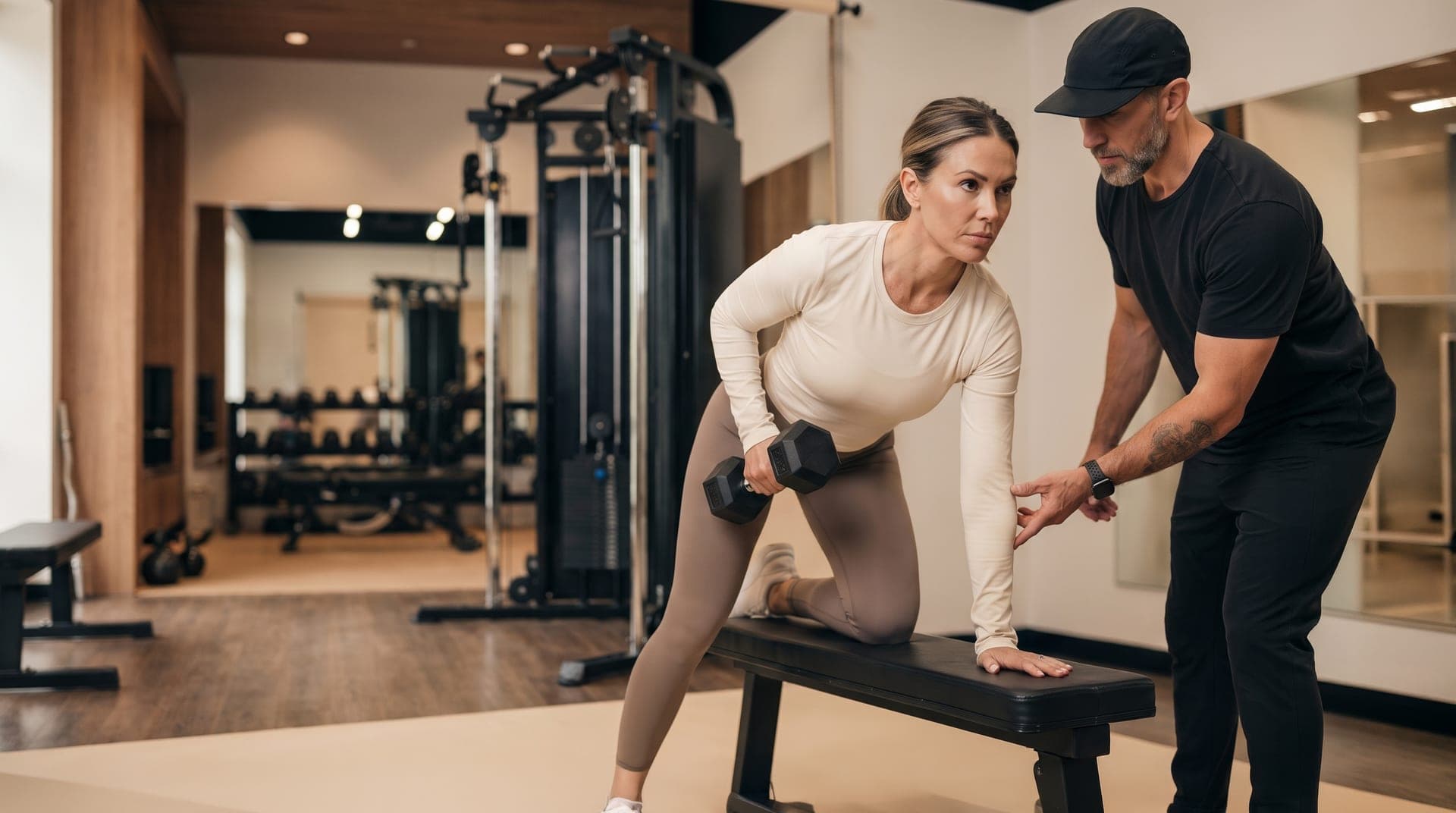
Five movement patterns cover almost everything: squat, hinge, push, pull and carry. Learn those well and you can build any program on top of them.
| Pattern | Beginner version | What it helps in real life |
|---|---|---|
| Squat | Sit-to-stand from a bench or box | Getting up from chairs and the floor |
| Hinge | Hip hinge with a dowel, then light dumbbells | Lifting things off the ground safely |
| Push | Wall or incline push-up | Pushing open doors, getting up after a fall |
| Pull | Band or cable row | Posture, carrying, back health |
| Carry | Holding dumbbells and walking | Groceries, grandkids, luggage |
Add a glute bridge and some simple balance work, like standing on one foot near a wall, and you have a complete beginner session.
How heavy should you lift as a beginner?
Heavy enough that the last two or three reps of a set feel like work, while you could still do two or three more with clean form. That's the target, set after set.
If you could do ten more reps, it's too light and your body has no reason to change. If your form breaks down, it's too heavy. Most beginners start too light because nobody told them it was safe to push, then wonder why nothing happens.
What does the first month look like?
Week by week, roughly like this:
- Week 1. Learn the five patterns with bodyweight or very light weight. Two sessions. Expect to feel a little awkward. Everyone does.
- Week 2. Same movements, a bit more load or one more set. Focus on the hinge, because lifting with a flat back is the most protective skill you can build.
- Week 3. Add weight wherever the last reps started feeling easy. Most women are surprised how fast this happens.
- Week 4. Two to three working sets per movement. You'll notice stairs, groceries and getting off the floor feel different.
Strength gains in the first few weeks are mostly your nervous system learning the movements. That's why they come so fast, and it's also why consistency matters more than intensity early on.
What about bones?
Lifting helps them too. The Bone Health and Osteoporosis Foundation recommends both weight-bearing and muscle-strengthening exercise for building and keeping bone density (BHOF).
If you already have a low bone density diagnosis, read strength training with osteoporosis: what's safe and what to skip first. A few movements need to come off the menu.
Does protein matter if you're just starting?
It matters a lot. Lifting tells your body to build muscle, and protein is what it builds with. Without enough, you get sore and tired without much to show for it.
The PROT-AGE group recommends at least 1.0 to 1.2 grams of protein per kilogram of body weight per day for adults over 65 (PROT-AGE, 2013), and active older adults at the higher end or above. If you have kidney disease, check with your doctor first. Full numbers by body weight are in how much protein women over 40 actually need.
What are the signs you're doing it right?
Your lifts go up, everyday tasks get easier, and you sleep a little better. Those show up long before anything changes on the scale.
Mild soreness a day or two after a new workout is normal and fades. Sharp pain, joint pain that lingers, chest pain or dizziness are not, and you should stop and check with your doctor. If you're also in the middle of menopause, how much strength training you need in menopause covers how to adjust.
Should you hire a coach to start?
You don't have to. A coach mainly saves you time and the most common mistakes: lifting too light, progressing too fast, and rounding your back on the hinge.
One pitch, labeled. If you're in Flower Mound and you'd rather learn this with someone watching every rep, here's how training for women over 40 works at my studio. The free 6-Week Challenge is built for exactly this first month and the five weeks after it.
Common questions
Is it too late to start strength training at 50?
No. Muscle responds to training at 50, 60 and well beyond. Starting later just means the first month is about learning movements and building tolerance instead of lifting heavy. The earlier you start, the more muscle you keep.
How often should a beginner over 50 lift weights?
Twice a week is the sweet spot to start, which matches the CDC's minimum of two days of muscle-strengthening for adults. Leave at least a day between sessions so you recover. Walking on other days is a great addition.
How heavy should I lift as a beginner?
Heavy enough that the last two or three reps of a set feel like real work, while you could still do two or three more with good form. If you could do ten more, it's too light. If your form breaks, it's too heavy.
Is it normal to be sore after starting to lift?
Mild muscle soreness a day or two after a new workout is normal and fades as you adapt. Sharp pain, joint pain that lingers, chest pain or dizziness are not normal. Stop and check with your doctor if you feel those.
Do I need a gym membership to start strength training?
You need something to progress with, whether that's dumbbells, bands, machines or a coach's studio. Bodyweight alone works for a few weeks, then most people need added load to keep improving.
Sources
- Physical activity guidelines for adults. Centers for Disease Control and Prevention.
- Sarcopenia. Office on Women's Health, U.S. Department of Health and Human Services.
- Exercise for your bone health. Bone Health and Osteoporosis Foundation.
- Evidence-based recommendations for optimal dietary protein intake in older people (PROT-AGE). Journal of the American Medical Directors Association, 2013.
This article is general fitness education, not medical advice. Check with your doctor before starting a new program, especially if you are pregnant, postpartum, on medication, or managing a health condition.