Women over 40
How much protein do women over 40 actually need?
Jonathon PirpichNASM-Certified Personal Trainer5 min read
The short answer
The RDA for adults is 0.8 grams of protein per kilogram of body weight a day, which is a minimum rather than a muscle-building target. Researchers who study aging muscle recommend at least 1.0 to 1.2 g/kg for adults over 65, and more if you're active. For a 150-pound woman that's roughly 68 to 82 grams a day, spread across meals, paired with strength training.
Most women I start with in their 40s and 50s are eating somewhere around half the protein they need to hold onto muscle. They aren't doing anything wrong. They're eating the way they always have, and the number that was fine at 30 quietly stopped being enough.
Here's how much you actually need, with the math done for you.
How much protein do women over 40 need per day?
More than the RDA. The RDA for adults is 0.8 grams per kilogram of body weight a day (Obesity, 2025), and it's a floor for basic needs rather than a target for keeping muscle as you age.
Researchers who study aging muscle go higher. The PROT-AGE study group recommends at least 1.0 to 1.2 g/kg a day for adults over 65, and 1.2 g/kg or more for those who are active (PROT-AGE, 2013). Their recommendations are for older adults, but the muscle problem they're addressing starts well before 65, which is why that range is a sensible target for active women in their 40s and 50s.
How much protein is that for your body weight?
Divide your weight in pounds by 2.2 to get kilograms, then multiply. Or just use the table.
| Body weight | RDA floor (0.8 g/kg) | 1.0 g/kg | 1.2 g/kg |
|---|---|---|---|
| 130 lb | ~47 g | ~59 g | ~71 g |
| 150 lb | ~55 g | ~68 g | ~82 g |
| 170 lb | ~62 g | ~77 g | ~93 g |
| 190 lb | ~69 g | ~86 g | ~104 g |
| 210 lb | ~76 g | ~95 g | ~115 g |
If you're carrying a lot of extra weight, these numbers run high, and a registered dietitian can help you set a target based on your goals. If you have kidney disease, check with your doctor before raising protein at all. PROT-AGE specifically flags reduced kidney function as an exception.
Why do women need more protein after 40?
Because muscle loss is already underway and it speeds up with age. The Office on Women's Health puts it at about 3 to 5% of muscle mass per decade starting around 30, becoming more noticeable by 60 (womenshealth.gov).
Muscle is what carries the groceries, protects your joints and bones, and burns calories while you sit. Protein is the raw material your body uses to keep it, and strength training is the signal that tells your body to bother. You need both. Protein without lifting doesn't build much muscle. Lifting without protein leaves your body short of building material.
What does 80 grams of protein look like in a day?
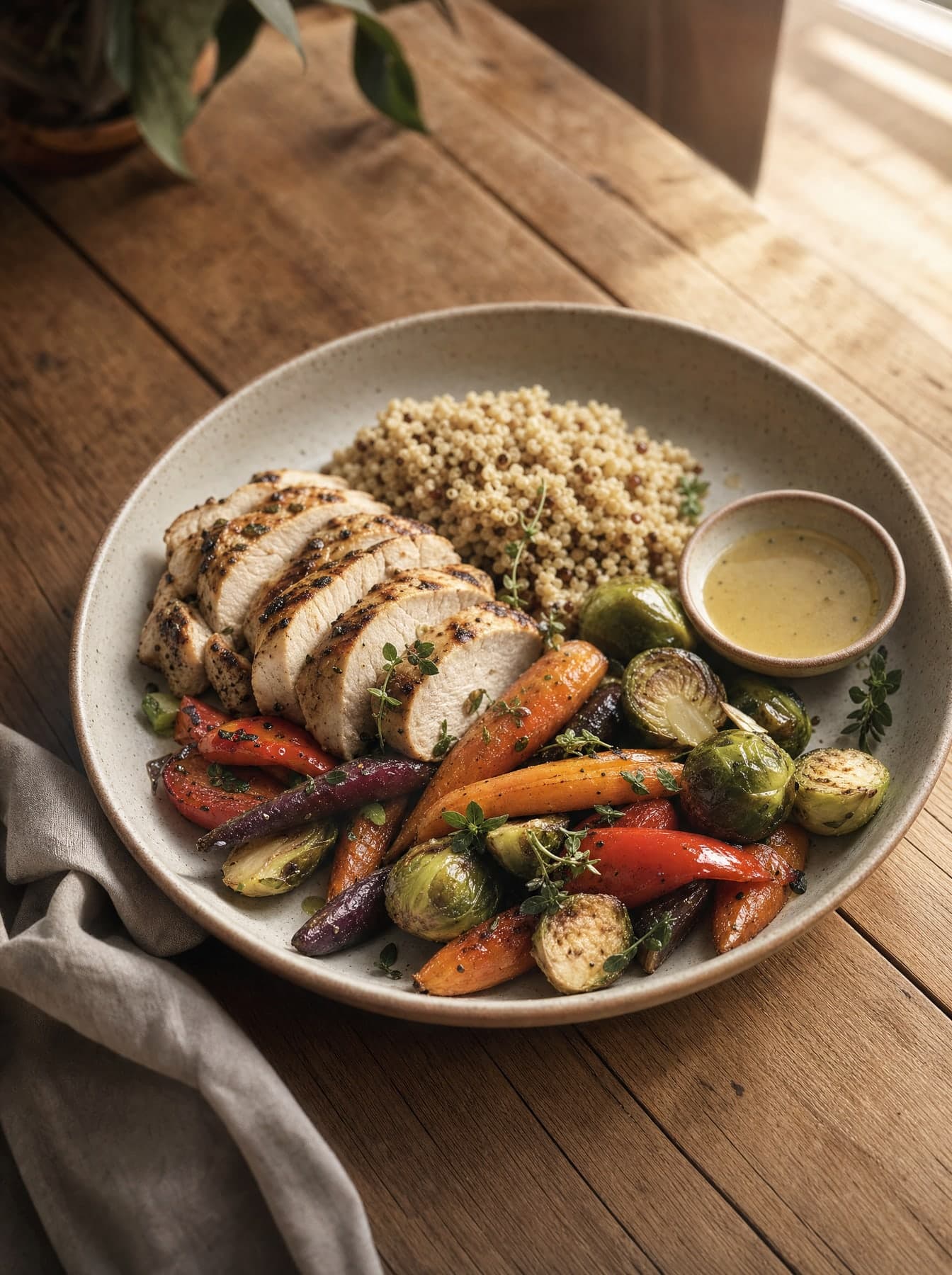
Less dramatic than it sounds when it's spread across four meals and snacks. Here's one example for a 150-pound woman aiming at the top of her range:
- Breakfast: 2 eggs and a cup of Greek yogurt (~29 g)
- Lunch: a big salad with 3 oz chicken (~26 g)
- Snack: 1/2 cup cottage cheese (~12 g)
- Dinner: 3 oz salmon and vegetables (~22 g)
That's ~89 grams. Notice there's nothing exotic in it. The difference between 45 grams and 85 grams for most women is one protein food per meal that wasn't there before.
Is breakfast the hardest meal for protein?
For most women, yes. Toast, coffee and fruit is a common breakfast and it carries maybe 5 to 10 grams. That one meal is usually where the biggest gap is.
Fixing breakfast alone often closes half the shortfall. Eggs, Greek yogurt, cottage cheese, leftover chicken, or a protein shake if mornings are chaos. If you're on a GLP-1 medication with a small appetite, the strategies are different, and they're covered in what to eat on Ozempic to keep your muscle.
Does protein timing matter?
The daily total matters most. Spreading protein across meals is a sensible habit mainly because it makes the total far easier to hit.
The PROT-AGE group looked at timing and decided the evidence wasn't strong enough for firm rules. So don't stress about a 30-minute window after workouts. Get a protein food at each meal, hit your daily number most days, and you've done the important part.
What should you pair with more protein?
Strength training, at least twice a week. That's the CDC's minimum for every adult (CDC), and it's what turns extra protein into kept muscle.
If you've never lifted, start with strength training after 50 when you've never lifted. If you have low bone density, read strength training with osteoporosis: what's safe and what to skip first.
Where to start this week
Weigh yourself once, find your row in the table, and track protein for three normal days. Most women are surprised by the gap. Then add one protein food to breakfast and see how far that gets you.
One pitch, labeled. If you're in Flower Mound and you'd like the meal plan built for you, here's how training for women over 40 works at my studio. The free 6-Week Challenge includes a custom meal plan and a Day 1 body-composition scan, so you'll know exactly what your muscle is doing.
Common questions
How much protein does a 150-pound woman over 40 need?
The RDA works out to about 55 grams a day for a 150-pound woman, but that's a minimum. Using the 1.0 to 1.2 g/kg range recommended for older adults by the PROT-AGE group, it's about 68 to 82 grams a day, more if she's lifting regularly.
Is the protein RDA enough for women over 40?
It covers basic needs, but it isn't designed to protect muscle as you age or while you're losing weight. Muscle loss runs about 3 to 5% per decade from around 30, so many women over 40 do better above the RDA, especially if they strength train.
Can you eat too much protein?
For most healthy adults, intakes in the ranges in this guide are well tolerated. The main exception is kidney disease: people with significantly reduced kidney function may need to limit protein, so check with your doctor first.
Should women over 40 use protein shakes?
A shake is a convenience. It's an easy way to add 20 to 30 grams when meals fall short, especially at breakfast. Whole foods like eggs, yogurt, fish and chicken cover most of it for most women.
Does protein timing matter?
Spreading protein across meals is a sensible, easy habit, and it makes the daily number much easier to hit. The PROT-AGE group noted that the evidence on exact timing was not strong enough for firm rules, so the daily total matters most.
Sources
- Evidence-based recommendations for optimal dietary protein intake in older people (PROT-AGE). Journal of the American Medical Directors Association, 2013.
- Nutritional priorities to support GLP-1 therapy for obesity: a joint advisory from ACLM, ASN, OMA and The Obesity Society. Obesity, 2025.
- Sarcopenia. Office on Women's Health, U.S. Department of Health and Human Services.
- Physical activity guidelines for adults. Centers for Disease Control and Prevention.
This article is general fitness education, not medical advice. Check with your doctor before starting a new program, especially if you are pregnant, postpartum, on medication, or managing a health condition.