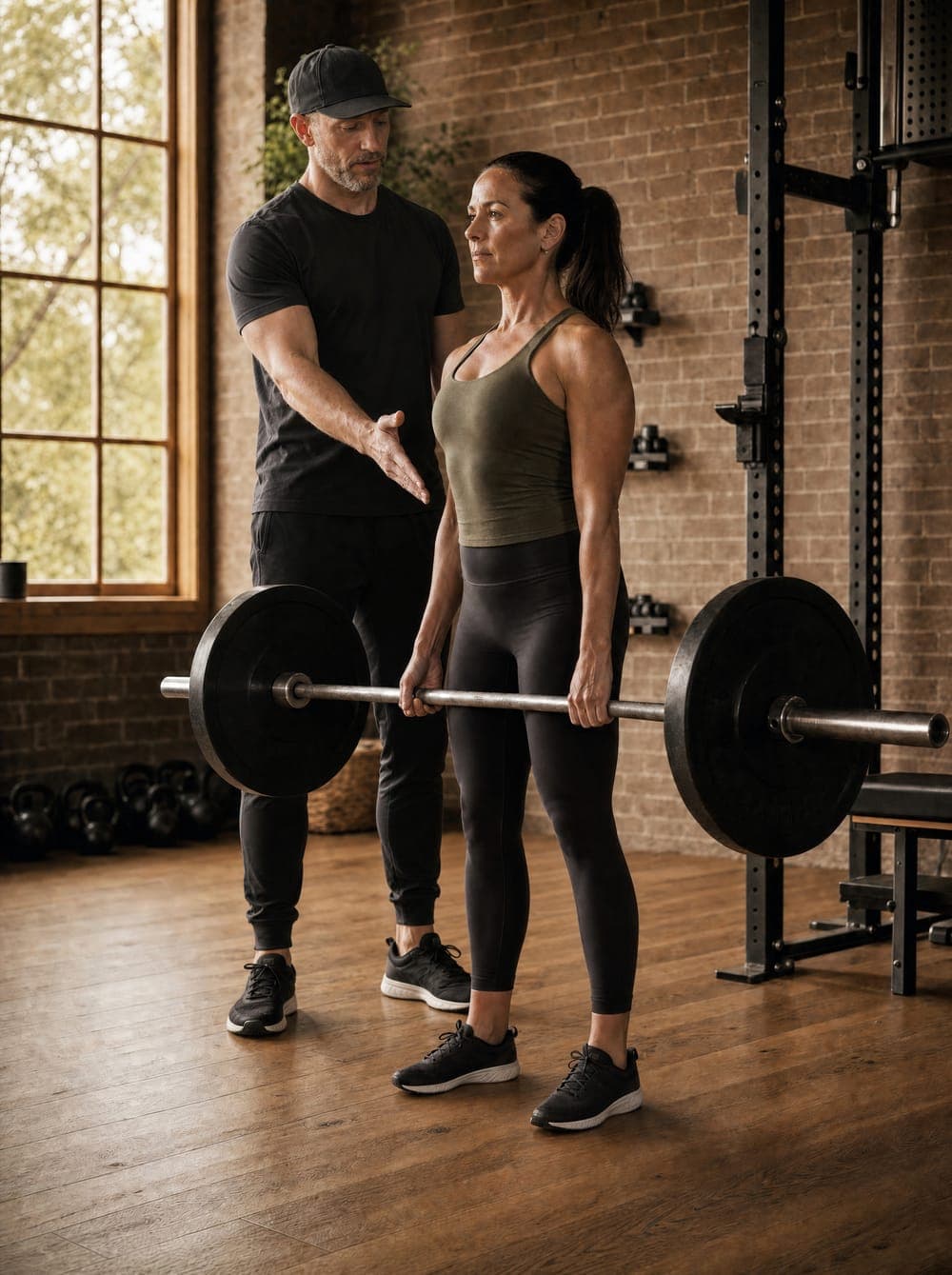
Choosing a trainer
How to choose a personal trainer in Flower Mound: 9 questions
Jonathon PirpichNASM-Certified Personal Trainer6 min read

The short answer
Pick a trainer who holds an accredited certification, writes you a plan for your body, includes nutrition, checks in between sessions, measures body composition instead of only weight, keeps you with the same coach every time, and doesn't lock you into a long contract. Ask all nine questions in this guide at a free consultation before you pay anything.
I run a training studio in Flower Mound, so yes, I have an obvious interest in how you answer this. Which is exactly why I'll give you the checklist I'd want my own family to use, even when it points them somewhere else.
The short version: the best trainer is the one whose system fixes the reason you quit last time. Here's how to find out, in nine questions.
What should you look for in a personal trainer?
Three things matter more than anything else: a real certification, a plan built for your body, and a system for the time between sessions. Personality matters too, but a great personality with no plan is just an expensive friend.
| Question | Good answer | Red flag |
|---|---|---|
| Certification? | Named, accredited, plus CPR/AED | "I learned by doing it" |
| Plan built for you? | Written, progressive, adjusted | Same workout as everyone |
| Nutrition included? | A written plan for you | "Just eat clean" |
| Between sessions? | Check-ins, texts | Nothing |
| How is progress measured? | Body composition + strength | Scale only |
| Same coach every time? | Yes | Whoever is on shift |
| Contract? | None, or short and clear | 12 months up front |
| Price? | Stated plainly, monthly total | "Let's talk after your workout" |
| Experience with people like you? | Specific, with examples | Vague |
1. What certification do you hold?
Ask for the name of it. "I'm certified" isn't an answer. The Bureau of Labor Statistics notes that personal trainers usually must be certified before working with clients, though requirements vary by facility (BLS), and most also need CPR and AED training.
Look for a certification accredited by the NCCA, the third-party body that audits fitness credentials. NASM's Certified Personal Trainer program, which I hold, is one of them (NASM). A weekend online course with no proctored exam is not the same thing.
2. Will my plan be written for me?
It should be. Your plan should account for your age, your injuries, your schedule and your starting strength, and it should progress on purpose, week to week.
If the answer is a class schedule or "we'll see how you feel," that's a class, priced like coaching. I covered the honest differences in semi-private vs group vs 1:1 personal training.
3. Is nutrition included?
For most adults trying to change body composition, food decides as much as the training does. Ask whether you get an actual written plan built for you or general advice like "more protein."
Then ask whether the plan changes as you go. A meal plan that never gets adjusted is just a PDF.
4. What happens between sessions?
This is the question that separates results from receipts. Two sessions a week is 2 of your 168 hours, and the habits that decide your results happen in the other 166.
Ask whether there are check-ins, how often, and by what channel. Daily texts, weekly calls, an app, nothing at all. "Nothing" is the most common answer, and it's the main reason people pay for months of training without much changing.
5. How do you measure progress?
Body composition and strength, ideally. The scale alone can't tell fat loss from muscle loss, and for women in their 40s and 50s that distinction is the whole game.
If a trainer only weighs you, ask how they'll know whether you're losing muscle. If they don't have a good answer, they won't know. The week-by-week timeline I'd hold any program to is in how long it takes to see results from personal training.
6. Will I have the same coach every session?
You should. Rotating trainers means nobody really learns how your body moves, what your sticking points are, or when you're quietly checking out.
It's a common frustration at big gyms: the trainer you liked leaves, and the new one starts from zero.
7. Is there a contract?
Ask what happens if you want to stop in month two. Long contracts aren't automatically bad, but a 12-month commitment before you've trained once is a sales tactic dressed up as a fitness plan.
The best answer is a short commitment you can see the end of, with no auto-renewal surprises. How we handle it, for comparison: how the $499 refundable challenge deposit works.
8. What does it cost per month, all in?
Get the monthly total, never just the per-session price. Add the membership, add any assessment fees, and ask what's not included.
In Flower Mound that monthly total ranges from roughly $250 for class formats to $1,400 for big-gym training with membership. The full table is in what personal training costs in Flower Mound.
9. Have you trained people like me?
Ask for specifics. If you're postpartum, in perimenopause, on a GLP-1 medication, or managing low bone density, you want someone who has done it before and can describe how they adjust the plan.
A good answer sounds like a process. A weak answer sounds like "oh yeah, all the time."
How do you check reviews properly?
Read the newest Google reviews and look for details over star counts. A review that names the coach, the timeline and a specific change is worth ten that say "great gym!"
Also look at how long reviewers say they've trained there. Long-term clients are the strongest signal there is that the system works after the honeymoon period ends.
What's the best next step?
Book free consultations with two or three trainers and ask every one of them the same nine questions. Bring the table above on your phone.
If you'd like to ask me, the free intro visit takes about 30 minutes, includes a body-composition scan and a custom meal plan, and you leave with both whether or not you join. It's also the first step of the free 6-Week Challenge. More about the studio: private 1:1 personal training in Flower Mound.
Common questions
What certification should a personal trainer have?
Look for a nationally recognized certification that is accredited by the NCCA, plus current CPR and AED training. The Bureau of Labor Statistics notes personal trainers usually must be certified, though requirements vary by facility.
What are red flags when hiring a personal trainer?
Guaranteed pounds by a date, a long contract before you've trained once, the same workout for every client, no plan for food, soreness treated as proof of a good session, and vague answers about price. Any one of those is reason to keep looking.
How do I find the best personal trainer in Flower Mound?
Read recent Google reviews for specifics instead of star counts, book a free consultation with two or three trainers, and ask each one the same nine questions. The right one answers clearly and doesn't pressure you to sign that day.
Should a personal trainer give me a meal plan?
If your goal is body composition, food matters as much as training, so yes, nutrition should be part of it. Ask whether you get an actual written plan for you or general advice, and whether it gets adjusted as you go.
How long should I try a trainer before deciding?
Give a good program about six weeks. Strength usually improves within two to three weeks, and body-composition change shows clearly by around six. If nothing has moved by then and the plan hasn't changed, ask why.
Sources
- Fitness Trainers and Instructors, Occupational Outlook Handbook. U.S. Bureau of Labor Statistics.
- NASM accreditation. National Academy of Sports Medicine.
- Physical activity guidelines for adults. Centers for Disease Control and Prevention.
This article is general fitness education, not medical advice. Check with your doctor before starting a new program, especially if you are pregnant, postpartum, on medication, or managing a health condition.